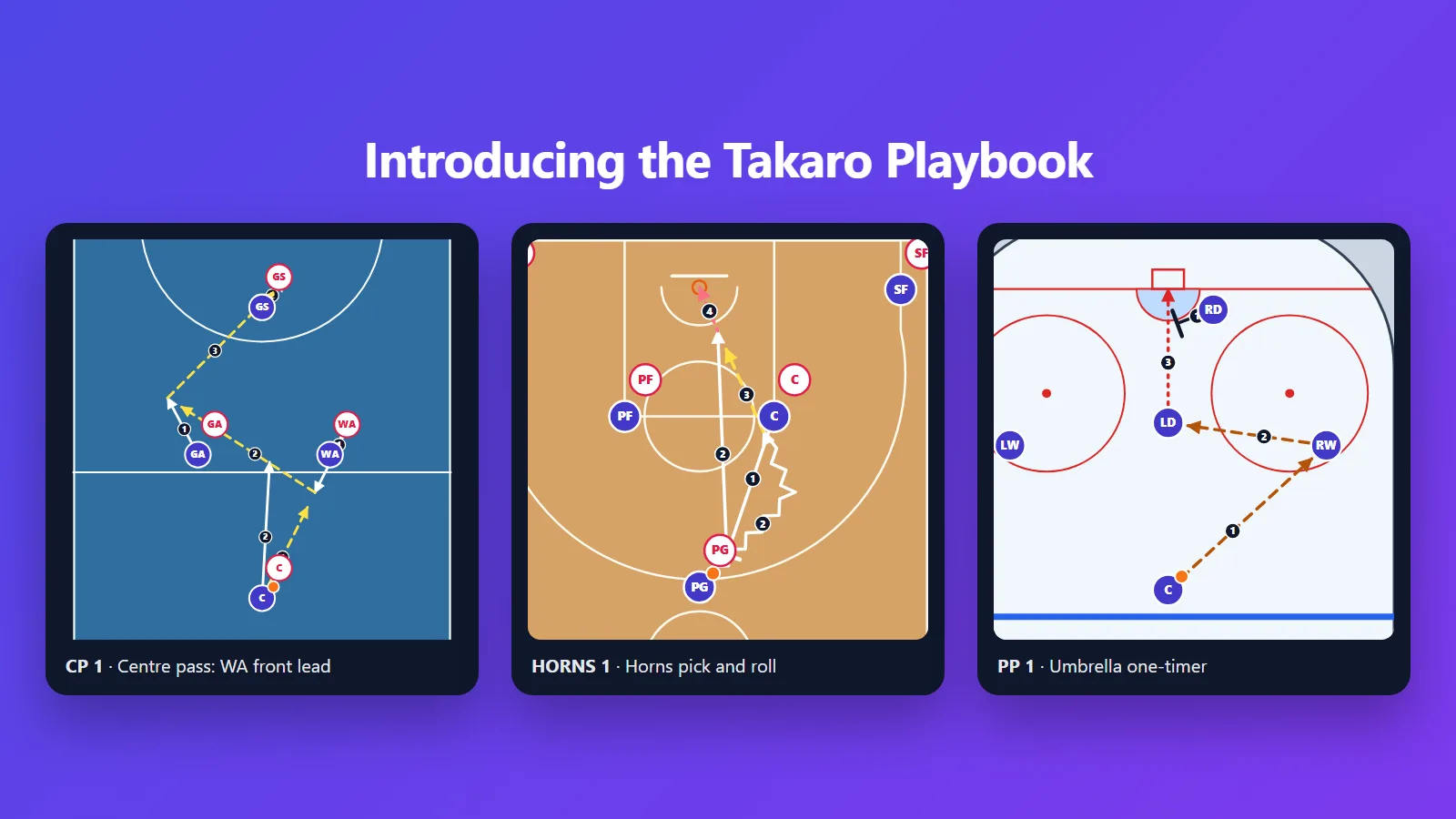
Quick answer: The Takaro Playbook is a play designer built into Takaro for team coaches. You draw set plays on a real court, rink or pitch for your sport, in numbered steps, and play them back as an animation. You can also describe a play in plain words and let AI draw it. It works for netball, basketball, football (soccer), field hockey, ice hockey, rugby, touch, water polo, volleyball and baseball, on the web and in the Takaro app, and you can start for free.
Every coach has a few plays in their head. The centre pass you drilled all week. The out-of-bounds set that finally worked on Saturday. The overlap your wingers keep forgetting.
Most of those plays live on a whiteboard, the back of a training plan or a blurry photo in the team group chat. That’s fine until you need to teach the play to a new player, explain it to a co-coach or remember it three weeks later.
So we built a proper playbook into Takaro.
What is the Takaro Playbook?
The Takaro Playbook is where your team’s plays live. Each play is a diagram on the right surface for your sport, with your positions, broken into steps.
- Step 1 might be the wing attack leading to the transverse line.
- Step 2 is the centre pass.
- Step 3 is the drive into the circle and the feed to the shooter.
Press play and Takaro animates it in order: players run, the ball moves, and everyone can see exactly who goes first and where the pass lands. It’s the difference between “you go there” and your team actually understanding the play.
Which sports does it support?
The playbook covers ten sports, each with its own court or pitch markings, positions, formations and starter plays:
| Sport | Surface | Starter plays include |
|---|---|---|
| Netball | Full court, or the attacking half | Centre passes, circle edge hold and roll |
| Basketball | Half court or full court | Horns pick and roll, box BLOB, 5 Out backdoor |
| Football (soccer) | Full pitch or attacking half, 11, 9 or 7-a-side | Wide overlap, third-man run |
| Hockey | Full pitch or attacking half, 11 or 7-a-side | Right-side overlap, circle entry, outlet from the back |
| Ice hockey | Full rink or the attacking zone | Breakout up the wall, low cycle, umbrella power play |
| Rugby | Union, sevens and Rippa pitch, or a league pitch for 13-a-side | Classic backline sweep, lineout off the top, Rippa two on one |
| Touch | Full field or attacking half, six a side | Half to the first receiver, wrap, two on one on the wing |
| Water polo | Full pool or attacking half, 6 + goalkeeper | Drive and pass, entry to the centre, 4-2 power play |
| Volleyball | Full court or our half with the net, six on court | High ball to the outside, three-person receive, pass-set-hit |
| Baseball | Full field or a zoomed infield | 6-4-3 double play, sacrifice bunt defence, steal second |
If you coach more than one sport, you get a separate playbook for each. Your netball plays never get mixed up with your basketball sets.
Draw a play with AI
This is the part coaches have loved most in testing.
Type the play the way you would explain it at training, for example:
“Horns: the centre screens for the point guard, point guard attacks the left side, centre rolls to the rim.”
Takaro places your players, draws each screen, run and pass in order, and opens the play as a draft. Drag anything that isn’t quite right, add a step, and save. It uses the same AI as Ask Takaro, and it knows the positions and markings of each sport.
What else is in the playbook?
- A play library. 155 rugby plays across union, sevens, league and Rippa, 66 for touch, and 60 each for netball, basketball, football, hockey, ice hockey, water polo, volleyball and baseball to copy and adapt: centre passes and circle entries, pick and roll and inbounds, corners and free kicks, penalty corners, lineouts, pod shapes and play-the-ball attack, wraps and rollball drives, ice hockey breakouts and power plays, water polo 6-on-5s, volleyball quicks, slides and serve receive, and baseball cut-offs and double plays. Each one has step-by-step captions, coaching points, common mistakes and a variation, which come with the play as notes when you copy it.
- A defenders layer. Add opponents to show how the play beats a defence, and hide them with one tap.
- Plays in your session plans. Add a play to a training session and it shows the live diagram, so your plan is always up to date.
- Match-day tracker. Open the playbook from the match screen and tap Worked or Broke down each time you call a play. After a few games you’ll know which plays to keep.
- Printable play sheets. Print your plays with their call codes for the bench or the clipboard.
- Undo, redo and autosave. Experiment freely. You can always step back.
- Web and app. Draw with a mouse at home or with your finger courtside on iPhone, iPad or Android.
How do I get started?
- Open Training in Takaro and choose your sport.
- Tap Playbook.
- Copy a starter play, start from a formation, or tap Draw with AI and describe your play.
- Add steps, press play, and share it with your team at training.
Every coach can preview the whole play library and keep up to three plays per sport for free. Paid coach and club plans add unlimited plays, AI drawing, the match-day tracker and printable play sheets. See pricing for details.
Frequently asked questions
Is the Takaro Playbook free?
Yes, you can start for free. Free accounts get every starter play and formation and can build three of their own plays per sport. Paid plans unlock unlimited plays, AI drawing, the match-day tracker and printing.
Can my players see the playbook?
Not yet. For now, playbooks are private to the coach who made them. Show the animation at training or print a play sheet. Sharing plays with players is on our roadmap.
Does it work on my phone?
Yes. The full editor is in the Takaro app on iPhone, iPad and Android, and your plays sync with the web.
Will more sports be added?
Yes. Netball, basketball, football, hockey, ice hockey, rugby, touch, water polo, volleyball and baseball are in. Tell us which sport you’d like next.
Try it this week
Pick the one play your team always gets wrong, draw it in Takaro and show it at your next training. Watching the play run step by step does more than another ten minutes at the whiteboard.